Instituto de Estudios sobre Desarrollo y Cooperación Internacional

Nazioarteko Lankidetza eta Garapenari Buruzko Ikasketa Institutua

Hegoa

Hemeroteca

Instituto de Estudios sobre Desarrollo y Cooperación Internacional

Nazioarteko Lankidetza eta Garapenari Buruzko Ikasketa Institutua

Últimas entregas

Tifariti

2025, Nº 2

Este número de la revista Tifariti incluye artículos escritos en árabe, español e inglés. Está estructurado en tres secciones: artículos evaluados por pares, ensayos y reseñas de libros. Los artículos incluyen contribuciones tanto de investigadores consolidados en sus ámbitos de especialidad, como de jóvenes académicos que inician su trayectoria investigando temas relacionados con el conflicto del Sáhara Occidental.

Editorial

Peer-reviewed articles

Activism, militancy and politics in the Western Sahara

  • Militancy and activism for self-determination in Western Sahara. Transgenerational political socialization in the Sahrawi refugee camps. Cord Beumer, Sijia Liu, Marie Antoinette N‘gouan, Judit Tavakoli
  • MINURSO through sahrawi eyes: a critical assessment of the UN mission in Western Sahara. Malainin Lakhal
  • The infeasibility of autonomy under the Kingdom of Morocco. Bouela Lehbib

Media analyses of the Western Sahara conflict: Historical and contemporary cases

  • A bilingual tool for Sahrawi ‘agency’? The bilingual daily La Realidad/al-Wāqiʿ and the last months of the Spanish Sahara (1975-1976). Maurizio Boehm
  • Brecha digital en el Magreb: Revisión sistemática cualitativa basada en el modelo de acceso digital de Van Dijk y Van Deursen, bajo lineamientos PRISMA. Carlos Miranda-Rodríguez
  • Sáhara Occidental: un vacío en los medios argentinos. Dayana López Villalobos

Ensayo

  • El té como vínculo de conexión intergeneracional para el pueblo del Sahara Occidental. Mohamed Ali Laman

Book reviews


Leer más aquí.

Climática

2024, Nº 4

La cuarta revista anual de Climática es un número especial con dos portadas y un diseño renovado. Sus 116 páginas incluyen reportajes sobre buenas prácticas e historias de éxito para defender la vida en el planeta. También sobre las distintas estrategias e iniciativas que provocan todo lo contrario, muy habituales en el día a día de gobiernos, empresas y lobbies.

El Magazine incluye historias que van desde España hasta África pasando por Latinoamérica. Ponemos el foco en el greenwashing, en los mercados de carbono y en otras prácticas habituales de los retardistas. Al otro lado de la revista, profundizamos en los litigios climáticos, en casos de éxito y en historia de cooperación y resistencia por un bien común.

Y todo ello te lo contamos de la mano de habituales de Climática como Eduardo Robaina, Azahara Palomeque, Andreu Escrivà, Patricia Simón, Juan F. Samaniego, Carro de combate, Manuel Ligero, Aida Cuenca, Elisenda Pallarés, pero también firmas internacionales como James Dykes, Theresa Leisgang y Marina Sardiña.


Leer más aquí.

Pikara Magazine

2025, Nº 13
¿Qué coño es lo natural?

Frente al horror organización, belleza y resistencia.

El anuario número 13 en papel tiene vida propia porque no lo hemos pensado nosotras, se ha pensado solo. Es el fruto de un año arrollador que nos asalta de evento histórico en evento histórico. Este anuario es un viaje que por momentos nos vuela la cabeza, pero también nos agita y da esperanza.


Más información aquí.

Revue internationale des études du développement

2025, Vol. 3, Nº 259
Résilience des communs à l’heure de l’anthropocène

La vulnérabilité systémique des environnements dans lesquelles évoluent les sociétés est (presque toujours) partagée comme une réalité à l’heure de l’anthropocène. Elle n’obère cependant pas les capacités individuelles et collectives – au sens d’agencéité – à penser des réponses, des adaptations et des transformations souvent contraintes. Dans ce dossier, nous posons comme cadre construit les relations étroites existantes entre savoirs et savoir-faire locaux, pratiques situées et capacité de résilience, loin de ses usages normés dans le champ de l’ingénierie du développement. Les contributions fournies nous invitent, en outre, à reconnaître le potentiel des mobilisations sociales et du droit afin de penser (et matérialiser) cette résilience/gouvernance des communs.


La vulnerabilidad sistémica de los entornos en los que evolucionan las sociedades es (casi siempre) una realidad compartida en la era del antropoceno. Sin embargo, esto no limita las capacidades individuales y colectivas —en el sentido de la capacidad de organización— para pensar en respuestas, adaptaciones y transformaciones, a menudo forzadas. En este dossier, planteamos como marco las estrechas relaciones existentes entre los conocimientos y las habilidades locales, las prácticas situadas y la capacidad de resiliencia, lejos de sus usos normalizados en el campo de la ingeniería del desarrollo. Las contribuciones aportadas nos invitan, además, a reconocer el potencial de las movilizaciones sociales y del derecho para pensar (y materializar) esta resiliencia/gobernanza de los comunes.


Más información aquí.

Postcolonial Studies

2024, Vol. 27, Nº 4
Knowing we share one fight

Articles

-Postcolonial cosmopolitanism: rethinking global politics. André Murgia

-Beasts, savages, barbarians, idolaters, and infidels: racialization in the chronicles of the conquest of the Canary Islands. Roberto Gil Hernández

-Decolonizing education: learning from ancient South Asian pedagogies for human and planetary health. Janaka Jayawickrama & Arnab Chakraborty

-A tale that time forgot: contemporary jungle-adventure cinema, imperial power, and the tourist gaze. Sofie Vermoesen & Lennart Soberon

Book Reviews

Review Essay


Más información aquí.

Climática

2025, Nº 5
Seamos águilas que montan en bici

Dividido en siete bloques temáticos de reportajes, con análisis y entrevistas intercaladas, el Magazine de Climática nº5 se presenta como una pequeña guía de posibles soluciones para continuar hacia adelante. Propuestas desde África, desde Australia, desde Europa o, ahora que celebran la victoria de Mamdani, desde Nueva York.

“¿Para qué va a ir en bici un pájaro si puede volar?”, nos dijo una persona cercana al ver la portada. Y aunque sabemos que tiene razón en la literalidad –un pájaro no puede montar en bici, obviamente– contamos la anécdota porque, sin pretenderlo, llenó aún más de sentido estas páginas: pese a tener soluciones a nuestro alcance, muchas veces no las vemos, porque queremos salidas rápidas, instantáneas, sin esfuerzo. Si no cambiamos la mentalidad, si no cambiamos el chip, seguiremos pensando como siempre, como hace décadas: para qué vamos a ir al trabajo en bici si tenemos el coche en la puerta, para qué vamos a coger un tren si es mucho más rápido pillar un vuelo.


Leer más aquí.

Ecología Política. Cuadernos de Debate Internacional

2025, Nº 70
Militarización

Este número de Ecología Política examina cómo los ejércitos, los paisajes militarizados y la industria armamentística generan destrucción ecológica, refuerzan dinámicas extractivistas y profundizan desigualdades, mientras sus impactos climáticos y ambientales permanecen en gran medida invisibilizados. A partir del concepto de necropolítica, los artículos exploran quiénes —y qué territorios— son considerados prescindibles en nombre de la seguridad, el desarrollo o incluso la sostenibilidad. Mediante estudios de caso históricos y contemporáneos, el dosier aborda la huella ambiental del militarismo, el militarismo verde, las tecnologías militares y digitales, así como las resistencias comunitarias y feministas frente a la militarización de la vida, contribuyendo a imaginar ecologías de esperanza.

Alternatives Humanitaires / Humanitarian Alternatives

2025, Nº 30
Aide en Danger: après le choc de 2025, les conséquences et la riposte

Nul ne l’ignore désormais, le second mandat présidentiel de Donald Trump marque une transformation radicale du paysage mondial. Ses décisions controversées et ses déclarations fracassantes redessinent les équilibres géopolitiques, touchant en premier lieu la solidarité internationale et, plus spécifiquement, l’action humanitaire.


Everyone now recognises that Donald Trump’s second presidential term marks a radical transformation of the global arena. His controversial decisions and dramatic announcements are reshaping the balance of geopolitics and impacting, above all, international solidarity and, more specifically, humanitarian action.


Leer más aquí.

Mujeres del Mundo = Munduko Emakumeak

2025, Nº Especial
25 urte

Aunque la canción dice que 20 años no es nada, nosotras afirmamos que 25 años de asociación, militancia, pelea por los derechos de todas son muchos, con cantidad de mujeres, amistades, tradiciones culturales, acciones, denuncias, creaciones, conexiones, alianzas, aciertos y errores. En definitiva, un buen recorrido, con sus aciertos y sus aprendizajes.

A los 25 años se les llama las bodas de plata, y es verdad que tras estos 25 años muchas de nosotras lucimos hilos plateados en nuestras cabezas, aunque también hay renovación en la asociación. Por ello, por lo ya realizado y por lo que queda por conseguir, seguiremos activas aprendiendo, denunciando, compartiendo, celebrando y disfrutando. En estos 25 años hemos pasado de enfrentar el racismo y defender la diversidad y la interculturalidad a reconocer la racialización y luchar por la decolonialidad. Hemos pasado de enfrentar las injusticias y las vulneraciones de derechos a seguir defendiendo los derechos y denunciando los privilegios. Y pasamos de trabajar con y para las mujeres a reconocernos como feministas plurales y diversas.

Siempre en compañía, siempre con flexibilidad, siempre con ganas de celebrar, sin saber si cumplimos 25 o 26 años, pero lo que sí tenemos claro es nuestra apuesta por la defensa de los derechos de todas las mujeres en todos los lugares del mundo. Seguiremos luchando hasta que todas seamos libres.


Abestiak 20 urte ez direla ezer esaten badu ere, guk esaten dugu 25 urte elkarte, militantzia eta guztien eskubideen aldeko borrokan asko direla, emakume, lagun, tradizio kultural, ekintza, salaketa, sorkuntza, konexio, aliantza, asmatze eta akats ugarirekin. Azken finean, ibilbide ona, bere asmatze eta ikaskuntzekin.

25 urteei zilarrezko ezteiak deitzen zaie, eta egia da 25 urte hauen ondoren gutako askok zilarrezko hariak badauzkagu gure buruetan, nahiz eta elkartean ere berrikuntza badagoen. Horregatik, egindakoagatik eta lortzeko geratzen denagatik, aktibo jarraituko dugu ikasten, salatzen, partekatzen, ospatzen eta gozatzen. 25 urte hauetan arrazakeriari aurre egin eta aniztasuna eta kulturartekotasuna defendatzetik, arrazakeria aitortu eta dekolonialtasunaren alde borrokatzera pasa gara. Injustiziei eta eskubide urraketei aurre egitetik,eskubideak defendatzen eta pribilegioak salatzen jarraitzera pasatu gara. Eta emakumeekin eta emakumeentzat lan egitetik, feminista pluralak eta askotarikoak garela aitortzera igaro gara.

Beti lagunartean, beti malgutasunez, beti ospatzeko gogoz, 25 edo 26 urte betetzen ditugun jakin gabe, baina argi duguna da munduko leku guztietan emakume guztien eskubideak defendatzearen alde egiten dugun apustua. Denok aske izan arte borrokan jarraituko dugu.


Más información aquí.

Politique Africaine

2025, Nº 177
Variations environnementales

La gestion de l’environnement est politique du fait des obligations de partager des ressources limitées, et de l’enjeu de leur préservation. Ce numéro documente les luttes ou les accommodements qui en résultent, des joutes interétatiques autour des barrages sur le Nil aux coopérations sur l’eau qui constituent un maillage entre administrations nationales en Afrique australe, ou aux stratégies des citoyens face aux aléas hydriques à la frontière entre le Tchad et le Cameroun. Les questions environnementales renouvellent aussi les imaginaires des territoires : les côtes dakaroises érigées en sites de loisirs renvoient à une «nature» mythifiée, et la peur des pénuries d’eau peut causer des conflits armés dans la Corne. Les questions liées à l’accès aux ressources naturelles façonnent les sujets politiques, à tous les niveaux de la hiérarchie sociale. Les questions écologiques sont aussi objets de mobilisations, pour les femmes dans les zones rurales du Sénégal comme autour de la gestion des déchets dans les mines d’Afrique du Sud. Ce varia rappelle que le prisme environnemental est au cœur des questions politiques actuelles en Afrique, par le haut comme par le bas.

Más información aquí.

RSS

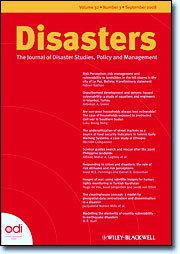
DISASTERS

Disa
Webhttp://www.blackwellpublishing.com/journal.asp?ref=0361-3666
PaísR.U. ODI OVERSEAS DEVELOPMENT INSTITUTE

Publicada por el ODI, Overseas Dvelopment Institute y Blackwell's. Tiene como objetivo proporcionar un foro de alto nivel sobre desastres naturales y políticas de emergencia en todo el mundo, promoviendo el intercambio de ideas y experiencias entre sus participantes. Publica tanto reportajes y artículos como estudios académicos. Contiene referencias bibliográficas y de conferencias. En Hegoa pueden consultarse desde 1999. Resúmenes de los artículos desde 1997, aquí.

Última entrega

  • Vested Interest theory and disaster preparedness. Claude H. Miller, Bradley J. Adame, Scott D. Moore.
  • Towards guidelines for post-disaster vulnerability reduction in informal settlements. Brent Doberstein, Heather Stager.
  • Disaster management and the critical thinking skills of local emergency managers: correlations with age, gender, education, and years in occupation. Stacy L. Peerbolte, Matthew Lloyd Collins.
  • ‘The Ethiopian famine’ revisited: Band Aid and the antipolitics of celebrity humanitarian action. Tanja R. Müller.
  • Media messages and the needs of infants and young children after Cyclone Nargis and the WenChuan Earthquake. Karleen D. Gribble.
  • Workplace response of companies exposed to the 9/11 World Trade Center attack: a focus-group study. Carol S. North, Betty Pfefferbaum, Barry A. Hong, Mollie R. Gordon, You-Seung Kim, Lisa Lind, David E. Pollio.
  • L'Aquila's reconstruction challenges: has Italy learned from its previous earthquake disasters?. Alpaslan Özerdem, Gianni Rufini.
  • Climate forecasts in disaster management: Red Cross flood operations in West Africa, 2008. Lisette Martine Braman, Maarten Krispijn van Aalst, Simon J. Mason, Pablo Suarez, Youcef Ait-Chellouche, Arame Tall.
  • Microfinance institutions and a coastal community's disaster risk reduction, response, and recovery process: a case study of Hatiya, Bangladesh. Gulsan Ara Parvin, Rajib Shaw.
2012, Vol. 36, Nº 4

-Disaster risk reduction in developing countries: costs, benefits and institutions. Charles Kenny

  • Gender and international crisis response: do we have the data, and does it matter? Lisa Eklund and Siri Tellier
  • The academic medical centre and nongovernmental organisation partnership following a natural disaster. Babak Sarani, Samir Mehta, Michael Ashburn, Koji Nakashima, Rajan Gupta, Derek Dombroski and C. William Schwab
  • Dignity and the right of internally displaced adolescents in Colombia to sexual and reproductive health. Marleen Bosmans, Fernando Gonzalez, Eva Brems and Marleen Temmerman
  • Connectedness, social support and internalising emotional and behavioural problems in adolescents displaced by the Chechen conflict. Theresa S. Betancourt, Carmel Salhi, Stephen Buka, Jennifer Leaning, Gillian Dunn and Felton Earls
  • Ocean waves and roadside spirits: Thai health service providers' post-tsunami psychosocial health. Emma Varley, Wanrudee Isaranuwatchai and Peter C. Coyte
  • Flood vulnerability and commercial activities: the case of the city of Girona, Spain. Lluís Ribera Masgrau and Anna Ribas Palom
  • Time needed to evacuate the Netherlands in the event of large-scale flooding: strategies and consequences. Bas Kolen and Ira Helsloot
  • Analysis of hazardous material releases due to natural hazards in the United States. Hatice Sengul, Nicholas Santella, Laura J. Steinberg and Ana Maria Cruz
2012, Vol. 36, Nº 3
  • Disaster risk reduction capacity assessment for precarious settlements in Guatemala City. Scott B. Miles, Rebekah A. Green and Walter Svekla
  • Enhancing disaster management by mapping disaster proneness and preparedness. Vishal Mishra, Sanjay Fuloria and Shailendra Singh Bisht
  • Social, not physical, infrastructure: the critical role of civil society after the 1923 Tokyo earthquake. Daniel P. Aldrich
  • Effects of the Bam earthquake on employment: a shift-share analysis. Nader Mehregan, Ali Asgary and Rouhollah Rezaei
  • Emotional and behavioural reactions to tremors of the Umbria-Marche earthquake. Gabriele Prati, Valeria Catufi and Luca Pietrantoni
  • Long-term gendered consequences of permanent disabilities caused by the 2005 Pakistan earthquake. Humaira Irshad, Zubia Mumtaz and Adrienne Levay
  • An analysis of seismic risk from a tourism point of view. Päivi Mäntyniemi
  • Inequalities in exposure and awareness of flood risk in England and Wales. Jane L. Fielding
  • The living environment and children's fears following the Indonesian tsunami. Ye Beverly Du, Christopher Thomas Lee, Desy Christina, Myron L. Belfer, Theresa S. Betancourt, Edward James O'Rourke and Judith S. Palfrey
  • An adaptive governance approach to disaster-related behavioural health services. Simon A. Andrew and James M. Kendra
  • Substance use among populations displaced by conflict: a literature review. Nadine Ezard
2012, Vol. 36, Nº Supplement 1
Urban vulnerability and humanitarian response
  • Urban vulnerability and displacement: a review of current issues. Sara Pantuliano, Victoria Metcalfe, Simone Haysom and Eleanor Davey
  • Displacement in urban areas: new challenges, new partnerships. Jeff Crisp, Tim Morris and Hilde Refstie
  • Protecting people in cities: the disturbing case of Haiti. Elizabeth Ferris and Sara Ferro-Ribeiro
  • Shelter strategies, humanitarian praxis and critical urban theory in post-crisis reconstruction. Lilianne Fan
  • Moving from the ‘why’ to the ‘how’: reflections on humanitarian response in urban settings. Elena Lucchi
  • Aid in a city at war: the case of Mogadishu, Somalia. François Grünewald
  • Jockeying for position in the humanitarian field: Iraqi refugees and faith-based organisations in Damascus. Tahir Zaman
2012, Vol. 36, Nº 2
  • From fatalism to resilience: reducing disaster impacts through systematic investments. Harvey Hill, John Wiener and Koko Warner
  • How much more exposed are the poor to natural disasters? Global and regional measurement. Namsuk Kim
  • Knowledge creation and reliable decision-making in complex emergencies. Bjørn Ivar Kruke and Odd Einar Olsen
  • Farming the battlefield: the meanings of war, cattle and soil in South Kivu, Democratic Republic of the Congo. T. Paul Cox
  • Epidemiological assessment of food aid in the Bosnian conflict, 1994–97. Neil Andersson, Sergio Paredes-Solís, Anne Cockcroft and Lorraine Sherr
  • Lessons from the 2006 Louisiana Health and Population Survey. Gregory S. Stone, Alden K. Henderson, Stephanie I. Davis, Michael Lewin, Iris Shimizu, Ramesh Krishnamurthy, Kris Bisgard, Robin Lee, Aisha Jumaan, Erin Marziale, Miranda Bryant, Clayton Williams, Karen Mason, Maria Sirois, Makiko Hori, Jonathan Chapman and David J. Bowman
  • A baseline assessment of emergency planning and preparedness in Italian universities. Fausto Marincioni and Rita Fraboni
  • The views of experts and residents on social vulnerability to flash floods in an Alpine region of Italy. Bruna De Marchi and Anna Scolobig
  • Modelling coordination in hospital emergency departments through social network analysis. Liaquat Hossain and Danny Chun Kit Guan
2012, Vol. 36, Nº 1
  • Coping strategies and risk manageability: using participatory geographical information systems to represent local knowledge. Graciela Peters-Guarin, Michael K. McCall and Cees van Westen
  • Complementing institutional with localised strategies for climate change adaptation: a South–North comparison. Christine Wamsler and Nigel Lawson
  • Cyclone preparedness and response: an analysis of lessons identified using an adapted military planning framework. Peter Tatham, Richard Oloruntoba and Karen Spens
  • Post-flooding disaster crop diversity recovery: a case study of Cowpea in Mozambique. Morag E. Ferguson, Richard B. Jones, Paula J. Bramel, Carlos Domínguez, Carla Torre do Vale and Jie Han
  • Latino social network dynamics and the Hurricane Katrina disaster. DeAnne K. Hilfinger Messias, Clare Barrington and Elaine Lacy
  • Controlling disasters: recognising latent goals after Hurricane Katrina. Lee M. Miller
  • Preventing corruption in humanitarian assistance: perceptions, gaps and challenges. Daniel Maxwell, Sarah Bailey, Paul Harvey, Peter Walker, Cheyanne Sharbatke-Church and Kevin Savage
  • The need for innovative strategies to improve immunisation services in rural Zimbabwe. Addmore Chadambuka, Anderson Chimusoro, Tsitsilina Apollo, Mufuta Tshimanga, Olivia Namusisi and Elizabeth T. Luman
2011, Vol. 35, Nº 4
  • Rebuilding and strengthening health systems and providing basic health services in fragile states. William Newbrander, Ronald Waldman y Megan Shepherd-Banigan
  • Human resources for health through conflict and recovery: lessons from African countries. Enrico Pavignani
  • Post-conflict health reconstruction: search for a policy. Leonard S. Rubenstein
  • Mother's body mass index as a predictor of infant's nutritional status in the post-emergency phase of a flood. Sophie Goudet, Paula Griffths y Barry A. Bogin
  • Supporting breastfeeding in emergencies: protecting women's reproductive rights and maternal and infant health. Karleen D. Gribble, Marie McGrath, Ali MacLaine y Lida Lhotska
  • An integrated approach: managing resources for post-disaster reconstruction. Yan Chang, Suzanne Wilkinson, David Brunsdon, Erica Seville y Regan Potangaroa
  • Remodelling reparation: changes in the compensation of victims of natural catastrophes in Belgium and the Netherlands. Véronique Bruggeman, Michael Faure y Miriam Haritz
  • A test of stress theory: relief workers in refugee camps. Hussein H. Soliman y David F. Gillespie
  • Facilitating disaster preparedness through local radio broadcasting. Eila Romo-Murphy, Ross James y Mike Adams
2011, Vol. 35, Nº 3
  • Tsunami survivors' perspectives on vulnerability and vulnerability reduction: evidence from Koh Phi Phi Don and Khao Lak, Thailand.
  • Evaluating post-Katrina recovery in Mississippi using repeat photography.
  • Repetitive flood victims and acceptance of FEMA mitigation offers: an analysis with community-system policy implications.
  • Social impact of the 2004 Manawatu floods and the 'hollowing out' of rural New Zealand.
  • Severe drought and the vitamin A status of rural preschool children in India.
  • The establishment of a standard operation procedure for psychiatric service after an earthquake.
  • Establishing moral bearings: ethics and expatriate health care professionals in humanitarian work.
  • Disaster coordination preparedness of soft-target organizations.
2011, Vol. 35, Nº 2
  • Dividing disasters in Aceh, Indonesia: Separatist conflict and tsunami, human rights and humanitarianism.
  • The role of the organisational psychologist in disasters and emergency situations.
  • Comparative analysis of permanent post-disaster houses contructed in Cankiri and Dinar.
  • Mother nature versus human nature: Public compliance with evacuation and quarantine.
2011, Vol. 35, Nº 1
  • The relationship between demographic/educational parameters and perceptions, knowledge and earthquake mitigation in Israel.
  • Information technology and emergency mangement: preparedness and planning in US states.
  • Pinning down vulnerability: from narratives to numbers.
  • Revisiting sphere: new standards of service delivery for new trends in potracted displacement.
2010, Vol. 34, Nº 4
  • Health sector recovery in early post-conflict environments: experience from southern Sudan.
  • Individual preparedness and mitigation actions for a predicted earhquake in Istambul.
  • Cyclone disaster vulnerability and response experiences in coastal Bangladesh. Emergency preparedness consultants at the local government level: the Israeli experience.
  • Between war and peace: humanitarian assistance in violent urban settings.
  • Doing good, but looking bad? Local perceptions of two humanitarian organisations in eastern Democratic Republic of Congo.
2010, Vol. 34, Nº 3
States of fragility: stabilisation and its implications for humanitarian action.
  • 'A tradition of forgetting': stabilisation and humanitarian action in historical perspective.
  • Stabilisation and humanitarian access in a collapsed state: the Somali case.
  • Stabilising a victor's peace? Humanitarian action and reconstruction in eastern Sri Lanka.
  • The United Kingdom's stabilisation model and Afghanistan: the impact on humanitarian actors.
  • Security for whom? Stabilisation and civilian protection in Colombia.
  • Aid and stability in Pakistan: lessons from the 2005 earthquake response.
  • Addressing symptoms but not causes: stabilisation and humanitarian action in Timor-Leste.
  • The effects of stabilisation on humanitarian action in Haiti.
2010, Vol. 34, Nº 3
  • Campaign contributions, lobbying and post-Katrina contracts.
  • Gauging the societal impacts of natural desasters using a capability approach.
  • Transformative experience for hurricanes Katrina and Rita disasters volunteers.
  • Fiji's wors natural disasters: the 1931 hurricane and flood.
  • Post-earthquake reabilitation of the rural water systems in Kashmir's Jehlum Valley.
  • Assessing the impact of the Indian Ocean tsunami on households: a modified domestics assets index approach.
  • Vulnerability of schools to floods in Nyando River catchment, Kenya.
  • Disasters response preparedness coordination through social networks.
  • Two solitudes: post-tsunami and post-conflict Aceh.
  • Symptomatic profile and health-related quality of life of persons affected by the Prestige catastrophe.
  • Optimazing hurricane disaster relief goods distribution: model development and application with respect to planing strategies.
  • Emergency safe spaces in Haiti and the Solomon Islands.
  • Minimization of socioeconomic disruption for displaced populations following disasters.
2010, Vol. 34, Nº 2
The social dynamics of Humanitarian Action
  • Community cohesion after a natural disaster: insights from a Carliste flood.
  • Lessons from a microfinance recapitalisation programme.
  • Organisational socialisation in a crisis context.
2010, Vol. 34, Nº 1

nº1 + supplemento